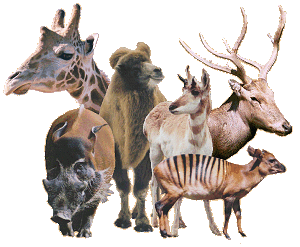
 The even-toed ungulates are the most successful
group of large herbivores on earth today, having outpaced the formerly widespread
perissodactyls in the Oligocene. Artiodactyls are indigenous to every
zoogeographic region (including several species on Sulawesi and other islands
in the Australasian region); they are not native to the continents of Antarctica
and Australia, but many species have been introduced into areas outside of
their natural range, including Australia, New Guinea, and the islands of
Oceania. The approximately 240 ungulate members of this order show incredible
diversity in size, form, dietary preferences, and climatic tolerance. This
order contains the majority of domesticated mammal species, including cattle,
reindeer, camels, pigs, goats, and sheep.
The even-toed ungulates are the most successful
group of large herbivores on earth today, having outpaced the formerly widespread
perissodactyls in the Oligocene. Artiodactyls are indigenous to every
zoogeographic region (including several species on Sulawesi and other islands
in the Australasian region); they are not native to the continents of Antarctica
and Australia, but many species have been introduced into areas outside of
their natural range, including Australia, New Guinea, and the islands of
Oceania. The approximately 240 ungulate members of this order show incredible
diversity in size, form, dietary preferences, and climatic tolerance. This
order contains the majority of domesticated mammal species, including cattle,
reindeer, camels, pigs, goats, and sheep.
Recent molecular evidence has radically reorder the classification of this order, notably proving that whales and dolphins (Order Cetacea) belong WITHIN this order. Some authors have proposed renaming the order "Cetartiodactyla" to reflect the new combination, while other have suggested retaining the two orders, but group them in a superorder, also titled the Cetartiodactyla. However, the general consensus among the scientific community is to retain the name Artiodactyla (which has priority) for the combined order of even-toed ungulates and cetaceans. Since they don't have hooves, whales and dolphins aren't included in this website - but you can check out the links section for some great cetacean websites!
There are three well-established suborders:
- Tylopoda - camels
- Suiformes - pigs and peccaries (and formerly hippos)
-
Ruminantia - the ruminants,
containing the majority of modern artiodactyl species
Like the suggested hybridized name Cetartiodactyla, the close allying of the hippopotamuses and cetaceans has created the need for a new suborder: - Cetancodonta - hippos, dolphins, and whales.
Ar·ti·o·dac·ty·la
(är'tee-oh dak ti'lah) |
Evolution
The highly specialized cetaceans are believed to have evolved from the Archaeoceti, a group of primitive whales known from fossils as early as 50 million years ago. The Archaeocetes were formerly thought to have arisen from Mesonychian ungulates based on morphological features. However, Mesonychians are known from fossil deposits 60 million years old - much earlier than the first artiodactyls. While it is now generally agreed that these shared characters are convergent, the fossil history of the cetaceans has yet to be fully resolved in relation to the evolution of the artiodactyls.
Diagnostic Characteristics
The nasal bones in the skulls of the artiodactyls are not expanded caudally, nor is there an alisphenoid canal. All species have a postorbital bar. Teeth are variable, but the upper incisors are always reduced or absent. Canines are usually small or not present at all, although in some species they are greatly enlarged into tusks. Two main types of molars are recognized - the brachyodont (low-crowned) teeth of the pigs, peccaries, and hippos, and the hypsodont (high-crowned) teeth of the camels and some ruminants.
(From Price, Bininda-Emonds, and Gittleman, 2005)
|
Camelidae
Cetacea
|
or jump to the Artiodactyla Species List